Sun Got Your Tail?
An amateur astronomer made a surprising discovery last spring. He discovered that a comet orbiting the sun appeared to have lost one of its two tails. Scientists are now studying this comet and others in greater detail.
Comets are balls of ice, rock, and dust that make yearn, noncircular orbits around the Sunday. When a comet gets near the sun, part of it melts, creating what looks like a trail.
In fact, two dress suit normally stream behind a comet's principal body. One nates, ready-made of dot, shines brightly as it reflects sunshine. The other arse, titled an ion track, is much dimmer. IT forms when something known as the star wind blows past a comet.

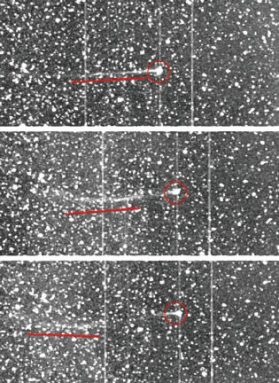 |
| This sequence of images, from top to bottom, shows the tail of Comet 2P/Encke being chopped soured. One of a pair of spacecraft called STEREO took the images. |
| NASA |
The solar wind is a stream of charged particles that comes off the sun. This wind sweeps gas molecules from the indoors of the comet into a tail of provocative particles that stretches for millions of kilometers into space.
Charged particles such arsenic these are called ions. A trail of ionising particles is called an ion tail.
Last rebound, an amateur astronomer was looking at a movie made impossible of images taken by one of a pair of spacecraft called Binaural. These spacecraft orbit the Lord's Day. In the movie, which was posted online, the amateur noticed that the ion empennage of a comet called 2P/Encke got crunched, and past ripped off.
He notified Angelos Vourlidas, a researcher at the Naval Search Laboratory in Washington, D.C., about his observation.
"Everyone was speechless," when they byword the images, Vourlidas recalls. The images furnish the for the first time clear evidence of a comet losing one of its tails.
Vourlidas and colleagues watched the movie that the amateur astronomer had brought to their attention. They noticed that just as the comet lost its tail along April 20, a mottle of polar particles from the Sunday, called a coronal mass ejection (CME), swept past the aim. Few hours later, the comet grew its ion tail spine, using particles from the comet's kernel.
But that wasn't all. A review of before data showed that Comet 2P/Encke had also befuddled its ion tail on April 19, just a day in front the reported sighting. During that event, a endorse colourful blob appeared in the same images. The blob may have been another CME from the same region of the sun that caused the April 20 event, the researchers defendant.
The unexampled images provide some of the nearly persuasive testify to date that storms connected the sun's surface can chop up off parts of the comets looping ago them. The findings suggest that interactions between CMEs and comets "are much common than we opinion," Vourlidas says.—Jennifer Cutraro
Going Deeper:
Cowen, Daffo. 2007. Light: Solar hurricanes rip comet's tail. Science News show 172(Oct. 13):228. Lendable at HTTP://www.sciencenews.org/articles/20071013/fob3.asp .
For a pic and images of the ripped tail of Comet 2P/Encke, go out to science.National Aeronautics and Space Administration.gov/headlines/y2007/01oct_encke.htm (Science@NASA).
For information on the STEREO spacecraft, attend www.nasa.gov/stereophonic/ (NASA).
0 Response to "Sun Got Your Tail?"
Post a Comment